Service Dog Tasks and the Public Access Test, Explained
This page explains the law in general terms. It is not legal advice. For a specific situation, contact the agency listed on this site or an attorney.
Two ideas sit at the center of service dog training: the tasks a dog performs and the public manners that let it work calmly around people. They are often mixed up. This guide explains what counts as a task under federal law, how to teach one step by step, and where the public access test fits in. It also covers the Colorado rules that apply to handlers and trainers.
If you are asking what tasks a service dog can do, the short answer is this: any task that is directly related to the handler's disability and that the dog has been individually trained to perform. The sections below break that down.
What counts as a task under the ADA
ADA.gov defines a service animal as a dog that has been individually trained to do work or perform tasks for an individual with a disability. Two parts of that sentence matter most: individually trained and work or tasks.
The task must be directly related to the person's disability. A dog that retrieves a dropped set of keys for someone with limited reach is doing a task. A dog that simply makes its owner feel happy is not, even if the benefit is real.
Colorado law follows the same line. Under C.R.S. 24-34-301, a service animal has the same meaning as in the ADA Title II and III regulations. The statute also treats emotional support animals as outside that definition.
Why comfort alone is not a task
Emotional support, therapy and comfort animals are not service animals under the ADA. Their presence may help a person, but the ADA asks whether the dog has been trained to do something specific. Calm companionship, by itself, does not meet that test.
The line can feel narrow with psychiatric disabilities. A dog trained to interrupt a panic episode by nudging, or to turn on lights and check a room for a person with PTSD, is performing trained tasks. A dog that is simply comforting by being nearby is not. Housing and air travel have their own separate rules, so check HUD and the Department of Transportation for those settings.
What tasks can a service dog do? Examples by disability
ADA.gov gives examples such as guiding people who are blind, alerting people who are deaf, pulling a wheelchair, alerting and protecting a person having a seizure, reminding a person to take medication, and calming a person with PTSD during an anxiety attack. The lists below build on those examples. They are illustrations, not a complete or official list.
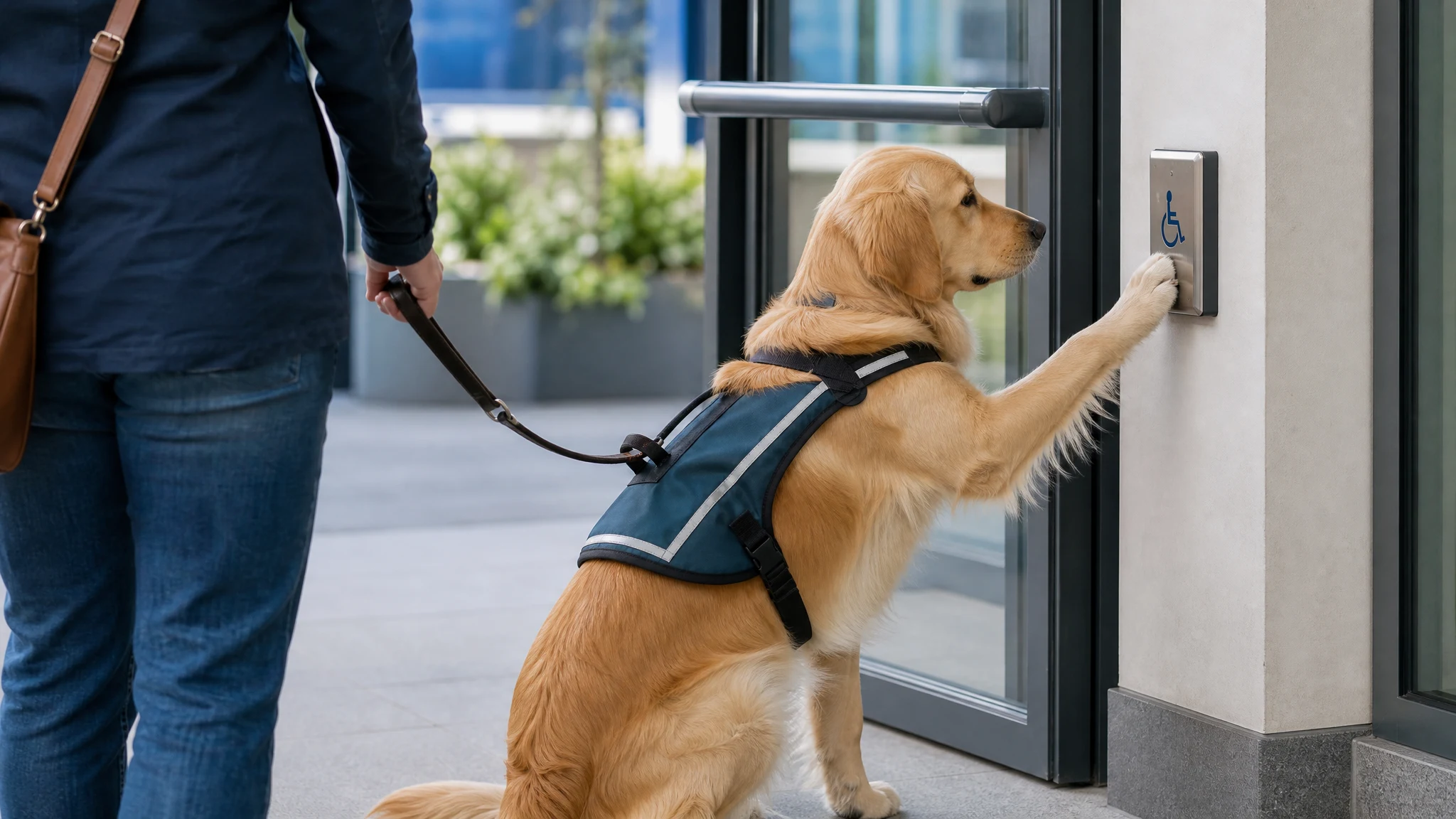
- Mobility disabilities: retrieving dropped items, opening and closing doors, bracing for balance support, pulling a manual wheelchair, turning light switches on and off.
- Vision disabilities: guiding around obstacles, stopping at curbs and stairs, locating doors or seats.
- Hearing disabilities: alerting to a doorbell, alarm, name call or approaching sound.
- Seizure disorders: staying with the person during a seizure, fetching help or medication, pressing a device button if trained.
- Diabetes and other medical conditions: alerting to a trained scent change or fetching supplies. Results vary by dog and condition.
- PTSD and other psychiatric disabilities: interrupting repetitive behaviors, creating space in crowds, room checks, waking a person from nightmares, reminders to take medication.
- Autism: interrupting self-harming behavior, tracking a child who bolts, providing grounding pressure on cue.
Each of these is a defined behavior with a cue or a trained trigger. That is what separates a task from a general benefit.
The public access test is a benchmark, not a legal requirement
A service dog public access test checks whether a dog behaves reliably in public: staying under control, ignoring distractions, and not disturbing others. Assistance Dogs International (ADI) publishes a public access standard that accredited programs use to evaluate their dogs. Colorado programs listed as ADI accredited include Canine Partners of the Rockies in Aurora and Freedom Service Dogs of America in Englewood.
The important point is that the ADA does not require a handler to pass the ADI test, or any test, to have public access rights. There is also no official service dog registry or required certification under the ADA. A certificate or ID card bought online is not legal proof of anything.
The test is still useful. It gives owner-trainers a clear, tested standard to work toward. It also gives you a way to judge honestly whether your dog is ready for stores, restaurants and clinics. Check ADI directly for its current test items, because standards can be updated.
The ADA does allow a business to ask a dog to leave if it is out of control and the handler does not take effective action, or if it is not housebroken. Good public manners protect your access in practice, even though no test is required on paper.
Materials you will need
- A well-fitted flat collar or a comfortable harness, and a standard leash. Do not use shock, prong or choke collars.
- Small, soft, high-value treats, plus your dog's regular food for lower-stakes practice.
- A clicker or a consistent marker word such as "yes."
- A mat or small bed for settling practice.
- Items for your specific tasks, such as a light-switch target, a pull strap, a retrieve object or a medication pouch.
- A notebook or phone app to log sessions and public outings.
- A training plan that follows reward-based methods, in line with the American Veterinary Society of Animal Behavior (AVSAB).
Step-by-step: teaching a task and preparing for public access
Step 1. Name the disability-related need
Write down what the dog will do and how it relates to your disability. "Brace so I can stand from a chair" is a task. "Make me feel better" is not. This also helps if a business asks the two permitted questions.
Under the ADA, staff may ask only whether the dog is required because of a disability and what work or task it has been trained to perform. They may not ask for documentation or a demonstration, or ask about the disability itself.
Step 2. Build a foundation of basic manners
Before any task, teach sit, down, stay, loose-leash walking, come when called and a reliable settle on a mat. Practice at home first, then in quiet outdoor spaces. Keep sessions short, usually a few minutes, and end while the dog is still keen.
Step 3. Mark and reward the first piece of the behavior
Break each task into small parts. To teach a door pull, for example, start by rewarding any nose or mouth contact with a strap on the handle. Mark the moment the dog does the right thing, then deliver a treat. Reward small steps often before asking for more.
Step 4. Add the cue and shape the full task
Once the dog offers the behavior reliably, attach a cue word or signal. Then gradually build toward the full task, such as pulling the door open and releasing the strap. For alerting tasks, a trainer experienced in scent or sound work can help you build a reliable trigger. Be careful to avoid rewarding false alerts.
Step 5. Generalize to new places and distractions
A dog that does a task perfectly in your living room may not do it in a pharmacy. Practice in new rooms, then at different times of day, then with mild distractions. Move up only when the dog succeeds most of the time at the current level. Go back a step if it struggles.
Step 6. Work through public access skills
Practice the kinds of skills public access tests usually look at. These include walking calmly through a crowd, ignoring dropped food, staying settled under a table, tolerating strangers' approaches, waiting at doors and handling elevators or stairs. Pick a few outings each week and keep them short at first.
Step 7. Run a mock public access test
Ask a friend to watch and score your dog on each skill, or record a video and review it later. Use the current ADI standard as your checklist. Note which items need more work and repeat them. If your dog shows persistent fear, reactivity or distraction, consider more time or a different role for the dog. Not every dog is suited to service work.
Step 8. Keep training and maintain skills
Tasks and manners fade without practice. Plan regular refreshers, and recheck skills after any big change such as a move, illness or new workplace.
Colorado rules to know while you train
Colorado law protects handlers and trainers. C.R.S. 24-34-803 says a qualified person with a disability may be accompanied by an individually trained service animal in employment, housing, public accommodations, public entity programs, public transportation and other places open to the public, without an extra charge. The same conditions and limits apply to everyone, and handlers are liable for damage the animal causes.
The same statute, at 24-34-803(2), gives trainers, and people with disabilities accompanied by an animal being trained as a service animal, the same access rights. A trainer is a person who individually trains a service animal. The sections reviewed here do not list age, harness or ID conditions for that right.
Colorado also penalizes misrepresentation. Under C.R.S. 18-13-107.7, intentionally misrepresenting an animal as a service animal or service-animal-in-training to gain rights under 24-34-803, after a prior warning and knowing the animal is not a service animal, is a petty offense. The fine is $25 for a first offense, $50 to $200 for a second, and $100 to $500 for a third or later. Interfering with or harming a service animal is a class 2 misdemeanor under C.R.S. 24-34-804(1)(d).
For a wider look at state rules, programs and costs, see our guide to service dog training in Colorado: laws, programs and costs. For a complaint about access, check with the Colorado Civil Rights Division for current instructions, or with the U.S. Department of Justice through ADA.gov. This article is not legal advice.
Tips and common mistakes
Tips
- Train tasks in very small steps. Dogs often learn faster when each step is easy to win.
- Keep a written log. It helps you spot patterns and shows steady progress over time.
- Practice settling as much as working. A calm dog under a table is a large part of public manners.
- Watch your dog's stress signals, such as lip licking, yawning, stiff posture or turning away. End the session if you see them.
- If you want guidance, look at ADI-accredited organizations such as Canine Partners of the Rockies or Freedom Service Dogs of America. Ask them directly about fees, waitlists and what they can offer. Both publish that they place dogs at no cost to the handler, but check current terms with each program.
Common mistakes
- Counting comfort as a task. Presence alone does not meet the ADA definition.
- Believing a certificate or registration is required. The ADA has no registry or required certification, and online sellers do not grant legal rights.
- Treating the public access test as law. It is a training benchmark from ADI, not an ADA requirement.
- Using punishment-based tools. Shock, prong and choke collars, alpha rolls, scruffing and dominance methods can damage trust and raise stress. They are not recommended.
- Rushing into busy places. Jumping straight to crowded stores often leads to setbacks.
- Skipping maintenance. Behaviors often weaken when practice stops.
What results to expect
With steady, reward-based practice, many dogs can learn reliable tasks and calmer public behavior, though timelines differ widely. Breed, age, temperament, health and the complexity of the task all play a part. Some dogs may take many months of regular work, and some may not be suited to service work at all.
Passing a mock public access test can suggest your dog is getting closer to ready, but it does not guarantee how the dog will act in every real-world setting. Plan to keep training and to reassess your dog's comfort and performance over its working life.