How to Owner-Train a Service Dog in Colorado: A Step-by-Step Plan
This page explains the law in general terms. It is not legal advice. For a specific situation, contact the agency listed on this site or an attorney.
Many people with disabilities train their own service dogs. It is legal, it is common, and in Colorado the law gives you a clear path to do it. It is also a long project. Most of the work is slow, steady practice.
This guide walks through how to train a service dog yourself, in five stages. At each stage it ties the work to Colorado law on dogs in training. It is a plain explanation of the law and not legal advice.
Key takeaways
- The ADA says a service animal is a dog individually trained to do work or perform tasks for a person with a disability (ADA.gov Service Animals FAQs). Owner training is one way to get there.
- Colorado law gives people who train service animals, and people with disabilities accompanied by an animal being trained, the same access rights as a trained team, without an extra charge (C.R.S. 24-34-803(2)).
- There is no official service dog registry or required certification under the ADA. You do not need to register your dog, and an online registration is not legal proof of anything.
- Work through five stages: screening, foundation obedience, socialization, task training and public access work.
- Use reward-based methods only. Bring in a professional trainer for task work.
- Knowingly misrepresenting a pet as a service animal is a petty offense in Colorado (C.R.S. 18-13-107.7).
What owner training means under the law
An owner trained service dog is a dog the handler trains personally, with or without help from a professional. The law does not require a program, a school or a certificate. It looks at what the dog has been trained to do and how the dog behaves.
The federal definition
According to the ADA Service Animals FAQs on ADA.gov, a service animal is a dog that has been individually trained to do work or perform tasks for an individual with a disability. The task must relate to the disability. Examples include guiding, retrieving dropped items, alerting to a sound, or interrupting a harmful behavior.
The same ADA.gov page says emotional support, therapy and comfort animals are not service animals under the ADA. A dog that comforts you by being near you is not doing work or a task in this legal sense. If your dog is trained to perform a specific task, such as applying pressure during a panic episode, that is different.
The Colorado definition
Colorado defines a service animal by reference to the ADA Title II and III regulations (C.R.S. 24-34-301). Colorado also recognizes a service animal in training. That is a dog or miniature horse being individually trained to do work or perform tasks for a qualified individual with a disability.
This guide covers dogs. For a wider look at Colorado statutes, programs and costs, see our overview of service dog training laws, programs and costs in Colorado.
Does your dog need an official listing or a certificate?
No. There is no official service dog registry and no required certification under the ADA. Sellers of online registrations, vests with ID cards and certificates have no legal authority. Do not pay for them as if they were required. What matters is the dog's training and behavior.
How the five stages fit together
| Stage | Main goal | Colorado law link |
|---|---|---|
| 1. Screening | Choose a dog with the right health and temperament | Training must be individual and aimed at your disability (C.R.S. 24-34-301) |
| 2. Foundation obedience | Reliable manners at home and nearby | Handlers are liable for damage their animal causes (C.R.S. 24-34-803) |
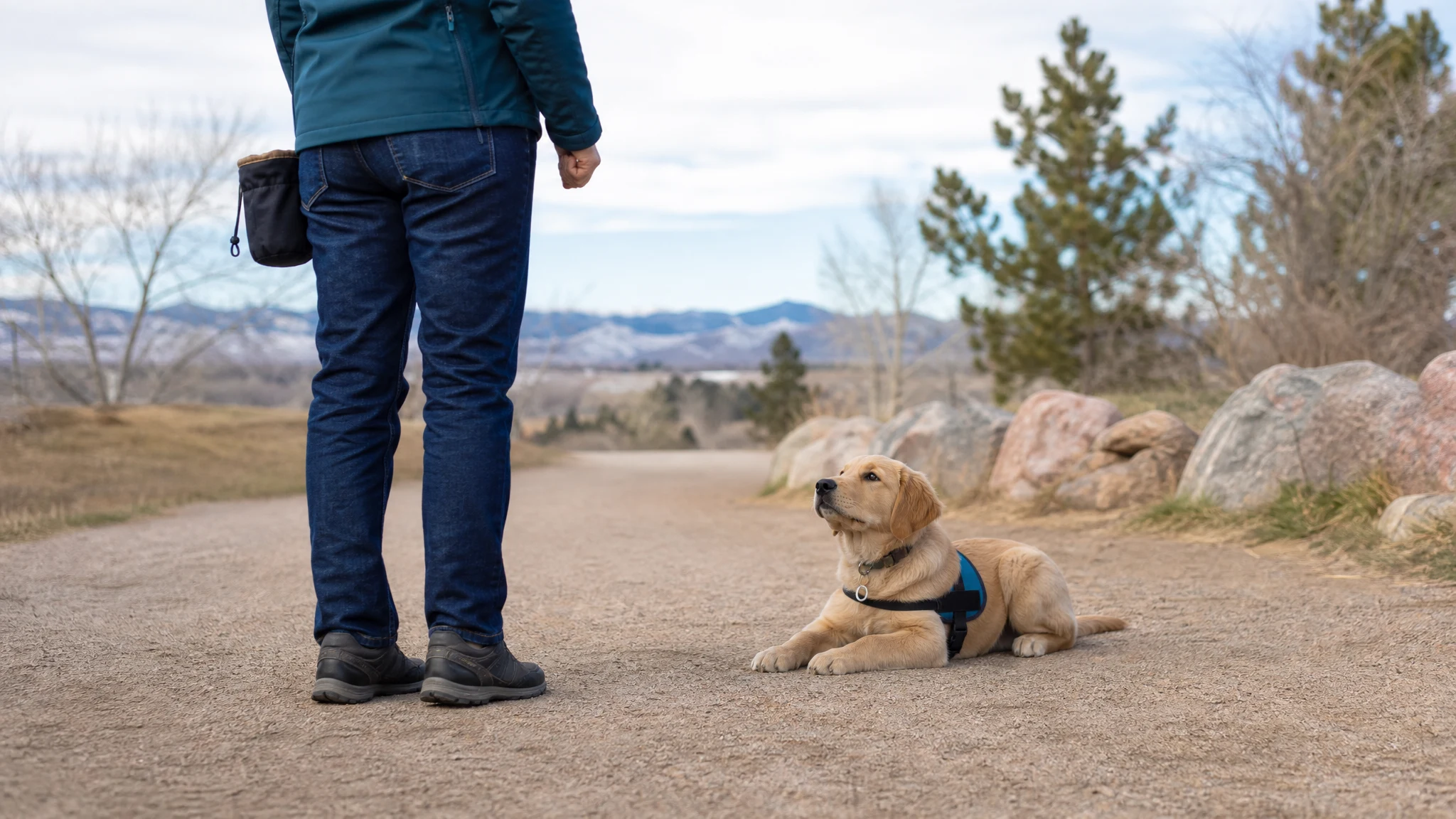
| 3. Socialization | Calm behavior around people, dogs and new places | In-training access rights apply in places open to the public (C.R.S. 24-34-803(2)) |
| 4. Task training | Dependable disability-related tasks | The task is what separates a service animal from a pet (ADA.gov) |
| 5. Public access work | Steady, quiet behavior in real settings | Same conditions and limits apply to everyone (C.R.S. 24-34-803) |
Stage 1: Temperament and health screening
Training a service dog starts before the first lesson. A dog that is fearful, reactive or in poor health will struggle with the job, however hard you work. Screening is how you protect both the dog and your own time.
What to look for in temperament
A good candidate is generally calm, curious and recovers quickly from surprises. Watch how the dog reacts to unfamiliar people, loud sounds, slippery floors and new smells. Look for a dog that stays interested in you and takes food and praise willingly.
Signs that a dog may not suit the work include persistent fear, guarding of food or toys, strong aggression toward people or dogs, and extreme excitability that does not settle with age and practice. Choosing a different dog is a sound decision, not a failure.
Health and physical fit
Ask your own veterinarian about joint health, vision, hearing and general soundness. This matters most for mobility work, where the dog may bear weight or pull. Size and strength should match the tasks you need. Breed alone does not decide this. Individual dogs vary widely.
Where to get a prospect
Some people start with a puppy and some with an adult dog. Some Colorado nonprofits place dogs that they train themselves. For example, Freedom Service Dogs of America in Englewood says on its site that its dogs are provided at no cost to those it serves, and Canine Partners of the Rockies in Aurora says it aims to place its mobility service dog at no cost to the handler. Check directly with each organization about eligibility and waitlists, since those details are not listed on the pages we relied on.
How Colorado law connects at this stage
Colorado's in-training rule covers a dog being individually trained to do work or perform tasks for a qualified individual with a disability (C.R.S. 24-34-301). So choose a dog you realistically expect to learn tasks that help with your disability. A dog that cannot handle public places can still be a good pet, but it should not be taken into places where only service animals and those in training are allowed.
Stage 2: Foundation obedience
Foundation skills are the base for everything else. Even if your dog will do very specific tasks, it needs to be easy to live with first.
Core skills to build
- Name response and eye contact. The dog turns to you when called.
- Sit, down and stay. Include a settle on a mat for longer waits.
- Loose-leash walking. The dog walks beside you without pulling.
- Recall. The dog comes when called, even with distractions.
- Leave it and drop it. The dog ignores dropped food and lets go of items.
- House manners. Reliable toileting, calm greeting, and no begging or counter surfing.
Use reward-based methods
Reward the behavior you want with food, praise, play or access to something the dog likes. Keep sessions short, five to ten minutes, and end on a success. Add duration, distance and distractions one at a time.
This approach follows the position of the American Veterinary Society of Animal Behavior (AVSAB), which favors humane, reward-based training. Do not use shock, prong or choke collars, alpha rolls, scruffing or dominance methods. They can raise fear and stress, which is the opposite of what a working dog needs.
How Colorado law connects at this stage
Under C.R.S. 24-34-803, handlers are liable for damage the animal causes. Reliable manners reduce that risk. They also protect your access, because a dog that is out of control creates problems for you and for every handler who comes after you.
Stage 3: Socialization
Socialization means helping your dog feel safe and neutral around the world it will work in. The goal is not a dog that loves everyone. It is a dog that stays calm and focused on you.
Build a gradual exposure plan
Introduce new things in small steps, starting at a distance where your dog stays relaxed. Pair each new thing with rewards. Cover a range of settings:
- Different floor surfaces, stairs and elevators
- Traffic, bikes, strollers and wheelchairs
- Crowds, children and people in hats or uniforms
- Other dogs at a distance, while the dog keeps its attention on you
- Car rides and, if you will use them, buses or trains
Let the dog watch and decide. Never flood a worried dog. If your dog shows lasting fear, talk with a professional trainer or your veterinarian before going further.
Colorado conditions to plan for
Colorado weather and terrain affect training. Hot pavement in summer, snow and ice melt in winter, and altitude on trips to the mountains can all stress a dog. Check paw comfort, bring water, and keep early outings short. These are practical tips and not legal rules.
How Colorado law connects at this stage
Colorado law gives trainers, and people with disabilities accompanied by an animal being trained as a service animal, the same access rights as a trained service animal team, without an extra charge (C.R.S. 24-34-803(2)). The statute pages we reviewed do not state age, harness or identification conditions for this right. Business owners may still ask you to control your dog, and the same conditions and limits apply to everyone (C.R.S. 24-34-803).
Having a legal right to bring a dog in training into a place does not mean every outing is a good idea. Take the dog only where it can behave. A dog that is overwhelmed learns the wrong lessons.
Stage 4: Task training
This is the stage that makes a dog a service dog. Under the ADA, the dog must be trained to do work or perform tasks related to your disability. Good manners alone are not enough.
Identify tasks that match your needs
Start by listing the specific difficulties your disability causes. Then ask what action by a dog could reduce or manage each one. Examples of the kind of tasks that can qualify include retrieving items, opening doors, bracing for balance, alerting to a sound, or interrupting a harmful behavior. Your needs decide the list. Your doctor or care team can help you think it through.
Break each task into small steps
The usual method is to reward tiny pieces of the behavior and build up. To teach a dog to retrieve a dropped item, for example, you might reward in this order:
- Looking at the object
- Touching it with the nose
- Picking it up
- Holding it
- Bringing it toward you
- Placing it in your hand
Add a cue word once the behavior is reliable. Then practice in more places and with distractions. Keep careful notes or video of progress. They help you see what works, and they record how the dog has been trained.
Bring in a professional trainer for task work
We recommend working with a professional trainer for task training. Tasks that involve your body, your balance or your health carry real risk if they are taught badly. A trainer can spot problems in timing and rewards that are hard to see yourself.
Look for a trainer who uses reward-based methods in line with AVSAB guidance and who has experience with service dog tasks. Ask how they train, what they do when a dog struggles, and whether they will coach you as the handler. Avoid anyone who relies on shock, prong or choke collars or dominance methods. We do not endorse particular trainers here, so ask for references and check them yourself.
How Colorado law connects at this stage
The state definition of a service animal in training depends on individual training for work or tasks (C.R.S. 24-34-301). Task training is therefore the heart of your claim to those rights. The person who individually trains a service animal counts as a trainer under the statute (C.R.S. 24-34-301), which is the legal footing for owner training.
Stage 5: Public access work
Public access work is where the foundation, socialization and task skills come together in real places. It is also the stage where your legal rights matter most.
What the dog should do in public
- Stay focused on you and ignore food, people and other animals
- Walk calmly on leash and settle under a table or at your feet
- Stay quiet, with no barking, lunging or sniffing merchandise
- Toilet only when and where you direct
- Perform its tasks when needed, even with distractions
Build up slowly. Begin with quiet, dog-friendly places, then move to stores, offices, restaurants and transit. End each outing while the dog is still doing well. If your dog is stressed or distracted, go home and go back a step.
What you can be asked
The ADA Service Animals FAQs say staff may ask only two questions when it is not obvious what the dog does:
- Is the dog a service animal required because of a disability?
- What work or task has the dog been trained to perform?
Staff cannot demand paperwork, ask about your disability or ask the dog to demonstrate its task. Practice a short, calm answer so you are ready.
Where Colorado law protects access
Under C.R.S. 24-34-803, a qualified person with a disability may be accompanied by an individually trained service animal in employment, housing, public accommodations, public entity programs and services, public transportation and other places open to the public, without an extra charge. The statute also says the mere presence of a service animal is not a violation of a sanitary standard.
The same statute covers dogs in training (C.R.S. 24-34-803(2)). Trainers and people with disabilities accompanied by an animal being trained have the same access rights, without an extra charge.
Pet-friendly is not the same as access
Many Colorado patios, breweries and trails welcome pets under their own rules. Those rules are separate from service animal law. When you are practicing public access work, keep your dog in work mode, with focus and quiet behavior, whatever the venue allows.
Colorado rules to know along the way
Misrepresentation
Under C.R.S. 18-13-107.7, intentionally misrepresenting an animal as a service animal or service animal in training to obtain rights under C.R.S. 24-34-803 is a petty offense. It applies after a prior written or verbal warning and with knowledge that the animal is not a service animal. The fines are $25 for a first offense, $50 to $200 for a second, and $100 to $500 for a third or later offense.
Do not label a pet or an emotional support animal as a service dog. A vest does not turn a pet into a service animal. Training does.
Interfering with a service animal
Under C.R.S. 24-34-804(1)(d), interfering with or harming a service animal is a class 2 misdemeanor. Treble damages apply for willful harm. If someone distracts or threatens your dog, you can point to that statute.
Housing
Colorado bars disability housing discrimination, including refusal of reasonable accommodations (C.R.S. 24-34-502 and 24-34-502.2). If a landlord requires documentation for an assistance animal, the landlord must give the tenant the Colorado Civil Rights Division's form if it is posted online. The tenant need not use that form (C.R.S. 24-34-309). Knowingly misrepresenting an assistance animal in housing is a civil infraction under C.R.S. 18-13-107.3, with fines of $25, then $50 to $200, then $100 to $500.
Employment
Under C.R.S. 24-34-803(3), an employer must let an employee with a disability keep the service animal with them at all times at work. The employer may not refuse to hire or discharge someone because of the service animal. The employer must also make reasonable accommodation unless it is an undue hardship, as defined in ADA Title I.
Licensing fees
A person with a disability who owns a service animal is exempt from state and local licensing fees for owning a similar animal (C.R.S. 24-34-803).
If your access is denied
Stay calm, state that your dog is a service animal and answer the two permitted questions. Note the date, place and names, and write down what was said. For complaints, check with the agency named in the statutes and on ADA.gov. We could not confirm a current complaint contact, so check with the agency for the correct process before filing. This is general information and not legal advice.
A realistic timeline and plan
We cannot promise a timeline or an outcome. Service dog training takes many months of regular practice, and some dogs do not complete it. A sensible plan looks like this:
- Screen the dog and talk with your veterinarian.
- Build foundation skills in short, daily sessions.
- Expand socialization step by step.
- Work with a professional trainer on tasks.
- Practice public access in easy places, then harder ones.
- Review the dog's health, behavior and willingness to work every few months.
If the dog is not suited to the work, choosing a different role for it, or a different dog, is a responsible choice.